What’s dominating your year-end conversations?
Be ready when your clients call. Show them what matters.
The goal isn’t more opinions—it’s clearer understanding
Concise, data-backed insights on the macroeconomic trends that matter directly from our Chief Investment Strategist, Tim Pierotti
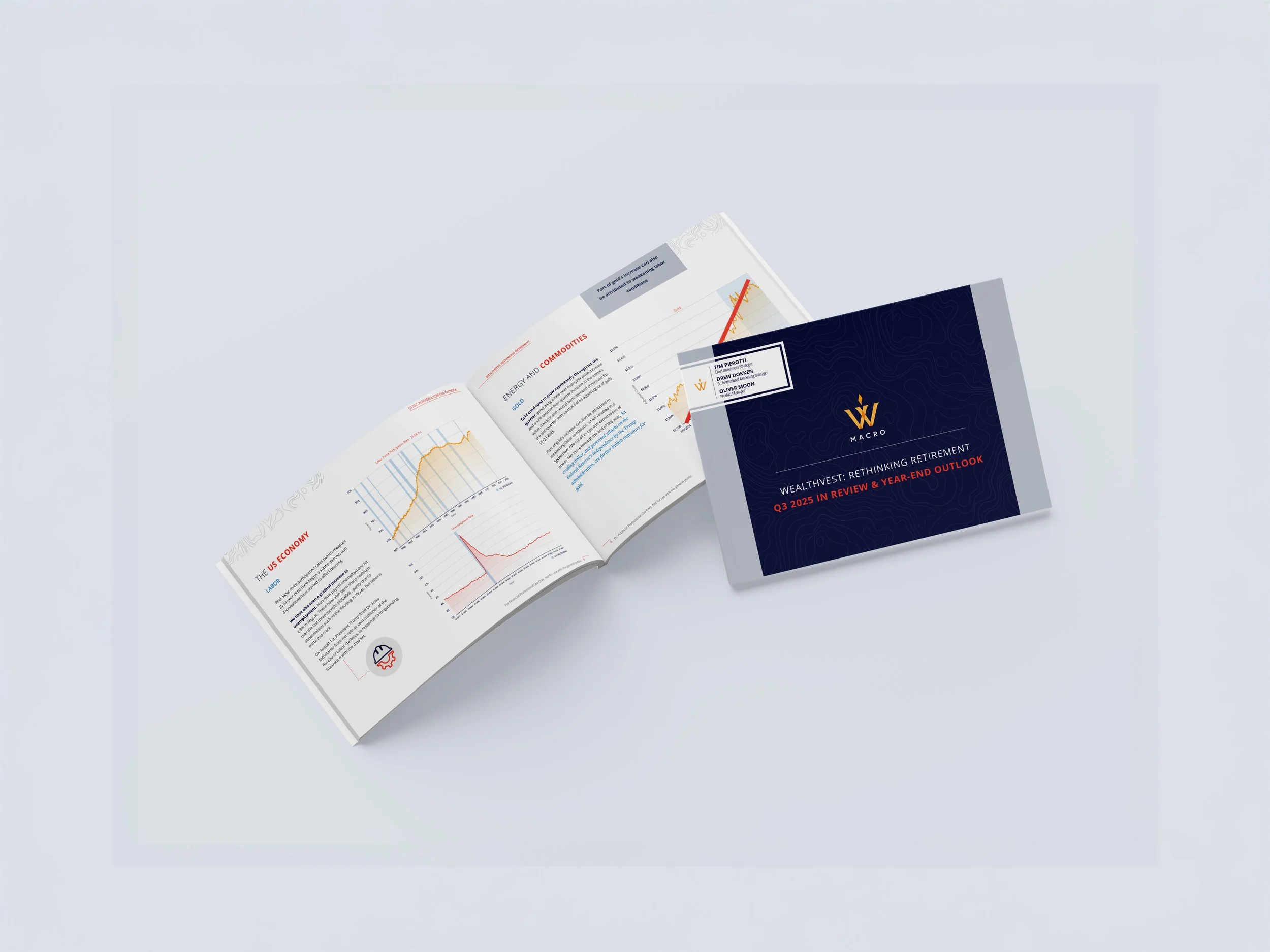

What you’ll get by downloading our Q3 in Review & Year-End Outlook
No Opinions, Just Data & Analysis
This report provides genuine insights rooted in market behavior, not speculation.Clear Client Talking Points
Use these insights to guide smarter, more confident conversations with your clients.Portfolio Strategy & Global Trend Breakdown
Understand the macro forces shaping Q4 and how to position portfolios accordingly.
I can join the chorus of people that are giving great feedback regarding Tim Pierotti’s presentation to my team. It’s refreshing to find an economist that can provide an economic update and subsequently translate that into how we can help our clients
Senior Executive, Program Manager
‘‘
Need a Speaker for Your Next Advisor or Client Event?
Bring the same market insights from the Q3 Review, live and in-person.
Tim Pierotti, Chief Investment Strategist at WealthVest, brings decades of market experience to audiences ranging from advisor group meetings to private client groups. Work with us to find out more about this service.

For more from WealthVest Subscribe to our Substack
For the past year, we have all heard Fed Governors and macro commentators argue that the Fed should “look through” tariffs and more recently, that the Fed should look through the oil price shock. Our view is that the Fed should look through nothing.
The news upsetting markets this morning is the President’s announcement that he will impose punitive tariffs on European countries standing in opposition to the US acquisition of Greenland. S&P futures are looking down by about 1.5%. The dollar is weak as are Treasuries and the crypto complex. Risk off and sell US based assets is the trend of the morning. Gold is up and silver is parabolic. The world has come to take the President’s tariff threats seriously and seem to be anticipating that the Europeans are finally willing to take aggressive measures specifically against globally dominant US technology companies.
Today, after much prayer and deliberation, I am launching my campaign to be the next Chairman of the Federal Reserve. Unlike the other candidates running for this office, I am running as a “Run it Cool” candidate. I know it’s a long shot given the President seems dead set on a candidate from the “Run it Hot” Party, but I think the President should hear me out, because the run-it-hotters might be good for markets near-term, but they sure aren’t going to help in the midterms.
“We see stocks rising 10% in 2026 to our new target of 7600 for the S&P (some will go to 8000 for the headline attention). We see earnings growing by 10-12% and we assume the earnings multiple to remain constant. We see the economy growing by 2-3% and for the US consumer to remain resilient. We do expect some volatility in markets, but we would be buyers on weakness. We expect the economic and inflationary impact of tariffs to fade next year and fiscal support from the “One Big Beautiful Bill” to support business investment. We believe that as inflation settles down, the Fed will cut two to three times. Our favorite sector remains mega-cap tech driven by the transformative and productivity-generating power of AI”
There is an old saying that I remember from my early days on Wall Street that “Only Fed Chairs who defeat inflation go to Heaven”. Given Chair Powell has allowed inflation to run above the 2% target for over four years, I’m not confident about his future ethereal direction of travel. In my experience over the years, at almost every FOMC press conference, Powell has sounded more dovish than I thought he would and has proven time and again to mistakenly underestimate the persistence of inflationary pressures.
Over the weekend, Renaissance Macro’s outstanding market economist Neil Dutta made a compelling argument that there is mounting evidence that a potential inflection in unemployment may be upon us.
Financial conditions are about as easy as they can be. The Fed is cutting rates and more cuts are expected. Some members of the Fed and the Treasury Secretary have successfully jawboned down the long-end of the Treasury market (and thereby mortgage rates) with talk of a “third mandate”.


This morning the Atlanta Fed published their “Nowcast” for US economic growth in the third quarter. Historically, it has made sense to take these nowcasts with a grain of salt early in the quarter but later in the quarter, as we are now, these forecasts become more accurate.


Markets appear to be discounting an economy that is weak enough to allow the Fed to aggressively cut rates, but not so weak that a recession that would impact corporate earnings might be looming.

We find the commentary hard to square with the market expectation of a cut in September. They may well cut, but it doesn’t sound like they think it’s a great idea.


Tim Pierotti dives into the differences between today's IPO speculation and retail enthusiasm and the reminiscent trends of 1999. The question looms: Are we on the brink of another bubble?


Two things can be true: This is a terrible job market for recent graduates and many other segments of the white-collar job market and yet nearly 40% of employers can’t fill open roles.

The neo-liberal consensus of free trade and integrated supply chains is under heavy strain due to growing populism in the developed world (which has seen stagnant wage growth) and in response to national security concerns. COVID-19 laid bare the glaring problems of not having domestic production in items such as pharmaceuticals and semiconductors. Both the Biden and Trump administrations have been focused on decoupling from China, albeit in very different ways. President Biden used the carrot in the form of industrial investment and corporate subsidies (i.e., the CHIPS and Science Act and provisions of Build Back Better). The Trump Administration has used the stick in the form of tariffs.

The housing market, in most of the country, is getting weaker. Activity remains slow, prices are negative across the Sunbelt, and inventory of both new and existing homes are moving to the highest levels since the GFC. Employment is getting weaker. Continuing unemployment claims are making new highs on a weekly basis and even initial jobless claims are finally inching up. Measures of credit delinquencies in credit cards and auto loans are also making new post GFC highs. Consumer confidence surveys tell us that the consumer is beyond pessimistic.

Last week the NY Fed published the results of a survey of regional manufacturers and service providers titled, “Are Businesses Absorbing the Tariffs or Passing Them On to Their Customers?,” Federal Reserve Bank of New York Liberty Street Economics, June 4, 2025.

Earlier this week, Axios interviewed Anthropic CEO Dario Amodei and they advertised the comments from Amodei with the stunning headline, “AI could wipe out half of all entry-level white-collar jobs.”
“We expect federal deficits to widen, reaching nearly 9% of GDP by 2035, up from 6.4% in 2024, driven mainly by increased interest payments on debt, rising entitlement spending, and relatively low revenue generation. We anticipate that the federal debt burden will rise to about 134% of GDP by 2035, compared to 98% in 2024.” Moody’s Friday May 16th

It is very unlikely we see a recession without a housing recession or an acceleration in the economy without housing leading the way.

Markets are intuitively rallying as it appears trade wars are ebbing and institutional investors find themselves wrong-footed. That said, tariffs have not gone away altogether, and they are and will be a regressive tax on working class Americans. They will also continue to disincentivize capital spending and hiring intentions.

Yesterday, Diamondback Energy (FANG), a $40 Billion exploration and production company in Texas, and a darling of Wall Street analysts wrote an extraordinary letter to shareholders. The CEO Travis Stice wrote the following:

CEO confidence recently hit the lowest level, by one measure, in fifteen years and yet Q1 earnings have been strong and ahead of Wall Street expectations.
Consumers, according to The Conference Board and the University of Michigan, are in a panic and yet spending at retail and among Visa customers show few signs of weakness.
Consumer confidence has taken a significant hit over the last couple of months and the impact of tariffs has not even materialized yet. Barring a policy reversal from the Trump administration, it is hard for us to envision an economic scenario that does not involve a recession when such a large cost of living shock is looming for working class Americans. - Tim Pierotti

"We don’t have a time machine. We can’t go back and re-write NAFTA or the terms by which China entered the WTO. We can play the hand which we are currently dealt. The US needs high ROI investment. The US needs to focus on ensuring that our population is the best educated in the world so that we continue to be the center of global innovation." - Tim Pierotti

The current consensus Wall Street narrative regarding this administration’s economic policy goes about like this: Bessent et al want to slow the economy to get rates down. With lower rates, companies will be able to refinance more cheaply and that will put the economy in a better position to grow longer term.

The decline of stocks and property held amid an increasingly concentrated minority risks economic weakness. The markets tail wags the economy dog.